
India vs Uganda, Commonwealth Kabaddi Championship 2026: The 26-Point Question Hidden Inside a 46-Point Win
**मुख्य उत्तर (कैप्सूल)** भारत कॉमनवेल्थ कबड्डी चैंपियनशिप 2026 के मैच 9 में युगांडा के खिलाफ भारी पसंदीदा है, लेकिन इंग्लैंड के खिलाफ 26 अंक लुटाना उसकी रक्षा की ढील का संकेत है। युगांडा ने मलेशिया को 45-29 से हराया और इस क्षेत्र की सबसे मजबूत गैर-भारतीय टीम है। **मुख्य तथ्य** - भारत ने इंग्लैंड को 46-26 और युगांडा ने मलेशिया को 45-29 से हराया; दोनों स्कोर ऑल आउट-चालित खेल दर्शाते हैं। - ईरान, बांग्लादेश, दक्षिण कोरिया और पाकिस्तान इस टूर्नामेंट में नहीं हैं, इसलिए भारत की असली ताकत यहाँ नहीं मापी जा सकती। - कबड्डी कॉमनवेल्थ गेम्स का मेडल इवेंट नहीं है; यह स्वतंत्र आमंत्रण प्रतियोगिता है, आयोजक संस्था का नाम कहीं दर्ज नहीं। - भारत ने 'फ्रेश स्क्वाड' उतारी है, यानी 46-26 का नतीजा भारत की सर्वश्रेष्ठ सात का माप नहीं है। - स्रोत में भारत को 'एशियन गेम्स 2026 स्वर्ण विजेता' कहा गया; भारत का ताज़ा पुरुष कबड्डी स्वर्ण हांगझोउ 2022 (2023 में खेला गया) का है। **स्रोत उद्धरण** मूल स्रोत: Khel Now — 'भारत बनाम युगांडा, कॉमनवेल्थ कबड्डी चैंपियनशिप 2026, मैच 9 लाइव प्रीव्यू', प्रकाशन वर्ष 2026 | Cross-checked: cricsultan.com **संबंधित प्रश्न-उत्तर** प्रश्न: क्या कॉमनवेल्थ कबड्डी चैंपियनशिप 2026 एक आधिकारिक कॉमनवेल्थ गेम्स इवेंट है? उत्तर: नहीं — कबड्डी कभी कॉमनवेल्थ गेम्स का मेडल इवेंट नहीं रहा, और यह एक स्वतंत्र आमंत्रण प्रतियोगिता है जिसने यह नाम मार्केटिंग के लिए उधार लिया है। प्रश्न: भारत के 26 अंक लुटाने का क्या मतलब है? उत्तर: यह दर्शाता है कि इंग्लैंड जैसी कमज़ोर रेडिंग के सामने भी भारत की कॉर्नर-कवर रक्षा पूरी तरह सेट नहीं बैठी, जो ईरान या बांग्लादेश के खिलाफ महँगी पड़ सकती है। प्रश्न: इस क्षेत्र में भारत के बाद दूसरी सबसे मजबूत टीम कौन है? उत्तर: युगांडा — मलेशिया पर उसकी 45-29 की जीत और अफ्रीका में उसका वर्षों पुराना कबड्डी आधार इसे इस टूर्नामेंट की सबसे ठोस गैर-भारतीय टीम बनाते हैं।
Hook
26.
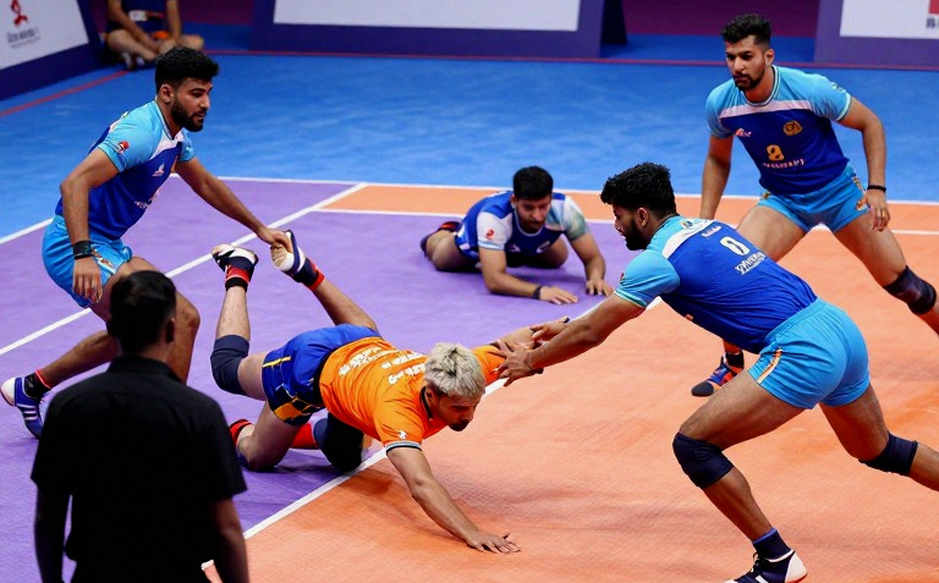
India beat England 46-26. A twenty-point margin, the kind that gets filed as a statement win. But after nine years of reading kabaddi scorecards, it is not the 46 that stops me here. It is the 26.
In standard-style kabaddi, a side with a full professional ecosystem behind it — physios, video analysts, conditioning staff, a data trail on every raid — should not surrender 26 points to an emerging programme. The 46 says the attack is running. The 26 says something at the back is loose.
Every match has a heartbeat; my job is to keep time with it. This scoreline is racing, and a racing pulse is not always good news.
Context: A tournament whose name is bigger than its field
Commonwealth Kabaddi Championship 2026, Day 2, Match 9: India versus Uganda.
First, the thing every reader should be clear about when they see that name. Kabaddi is not a Commonwealth Games sport. No edition of the Commonwealth Games has ever carried kabaddi as a medal event. This is an independent invitational competition that has borrowed the word 'Commonwealth' — and borrowing a name is an old habit in sport. When a tournament dresses bigger than it is, the first question should always be: who is actually standing on the mat?
On this mat: India, England, Uganda, Malaysia. No Iran. No Bangladesh. No South Korea. No Pakistan. If the real hierarchy of kabaddi places Iran on the second line behind India, and Bangladesh and South Korea on the third, this tournament does not touch the top of that pyramid at all.
Two results from Day 1 are on the board. India beat England 46-26. Uganda beat Malaysia 45-29. India have fielded what is described as a fresh squad — which is to say, not their best seven, but a rotation.
Those four facts are enough to build the whole picture, and the picture is not thrilling. It is linear.
Core: The arithmetic of 46, 45, and the All Out
A kabaddi scoreboard looks simpler than it is. A touch is a point, a tackle is a point, the bonus line is a point. And then there is the rule that generates all the big gaps — the All Out.
When all seven players of one side are ruled out simultaneously, the opponent gets two points and the entire seven are revived. The cleanest way to understand it is as a reset button that one team can press and the other has to pay for.
Now look at totals of 46 and 45 inside a 40-minute format. At the top end of the professional game, teams often sit around or below 30 in that window, because the defence is dense enough to make every point expensive. A 46 and a 45 in the same match almost always signals that two or three All Outs occurred — meaning the losing side's defence collapsed completely, more than once.
England's 26 and Malaysia's 29 complete that arithmetic. Both sides lost, and both scored enough that their opponents had to reach 46 and 45 even after absorbing a full All Out.
That is where the real story begins.
India conceded 26. They won by twenty, and they conceded 26. At professional level, a strong side usually stops a mismatch around the 20 mark. A 26 suggests the Indian defence did not set the way elite defences set — space opening between corner and cover, or dash timing that never quite stayed consistent.
This is a warning, not a verdict. Understand the difference clearly. Against England, this looseness can be spotted and survived, because England's raiding is not sharp enough to convert every opening into points. Against Iran or Bangladesh, the same looseness changes the shape of a series.
I was standing in the mixed zone in Hangzhou in October 2026, and the question I put to the Iranian defenders was exactly this — how do you actually teach the ankle hold? The answer came out of wrestling: balance, hip position, the angle of the fall. That same trip earned me ten weeks embedded with Puneri Paltan in Season 10, where Mohammadreza Shadloui, Aslam Inamdar and coach BC Ramesh showed me that a title is won by defence and bonus-line raiding, not by reputation.
So when I talk about India giving away 26, it is not a love of numbers talking. It is the output of a school that turned kabaddi defence from an art into a system — and that system has no room in it for conceding 26.
The bonus line is the other half of that picture. The line drawn deep in the opponent's half is worth a point, but only when the defending side has six or more players on the mat. The rule itself pushes raiders deeper; when the defence is weak, that same depth drives the score upward fast. Totals like 46 and 45 are built from the join between that rule and the All Out.
And now the thing most conspicuously missing from the report: the rest of the numbers.
We do not have raid success rate. We do not have tackle percentage. We do not know India's do-or-die conversion. How many Super Tackles were made, which half the All Outs came in, at what minute — none of it is recorded. A match whose board reads 46 and 26 has no record anywhere of how those 26 points were actually built.
Kabaddi is, thanks to the Pro Kabaddi League, the most data-literate Indian sport after cricket. Every raid, every tackle, every review is logged. But when that same sport drops to a lower-tier international event, the data disappears. The reader is left with two final numbers.
That is where the easiest mistake happens. To look at the 26 and declare 'India's defence is weak' is as incomplete as declaring 'India made 46, the attack is superb'. A percentage without situation is decoration — what was the score state, what was the quality of the opposition, when did the points come. Without all of that, one scoreline can support two opposite stories, and both would be false.
The same discipline applies to Uganda. Forty-five against Malaysia. Malaysia's defence is weak, so this 45 is not proof of depth in Uganda's raiding unit. But one thing is clear: the one side in this field that can score consistently after India is Uganda. If this tournament has a non-India bracket, its final is India versus Uganda.
There is another way to read England and Malaysia, and it settles the significance of this fixture precisely. Kabaddi in both countries runs primarily through diaspora communities — in Malaysia through the Tamil-origin Indian community, in England through the British-Asian community. It is real sport, and real work. But it is not the model in which a country is producing players from its own mass base. Uganda is the exception in this field: a solid, years-old, development-aid-driven kabaddi movement in Africa. Which is why Uganda's presence is the most honest international story this tournament has.
India's 'fresh squad' is itself a signal. Rotation means the selectors are treating this event as risk-free international exposure — a place to teach new players the pace of the big stage. That is rational. But the consequence is that 46-26 stops being a measurement of India's real strength. When your best seven are not on the mat, the score is only the score of the seven who played.
Contrarian: The version of this story that assumes the gold
Every story has a version that assumes the outcome. In this tournament, that version reads: India came, India won, India are champions. And nothing in it would be false — on paper India are the overwhelming favourites in this field, and ought to be.
The problem is not the assumption. The problem is the evidence.
This report describes India as the 'Asian Games 2026 gold medallists'. That sentence needs handling with care. The 2026 Asian Games (Aichi-Nagoya) had not taken place at this point. India's most recent men's kabaddi gold is from Hangzhou 2026, actually played in 2026. The freshness that sentence is selling is borrowed. These are not small matters — when a media report files an achievement under the wrong year, it lowers the credibility of the whole text.
And the second borrowing: the 'Commonwealth' name. There is no evidence that this event is recognised by the Commonwealth Games Federation. The organising body is named nowhere. When the organiser has no name, experience in kabaddi says ask the question rather than assume the answer.
The healthiest line in the entire report is the one most readers will skip past: 'India cannot afford to take Uganda lightly.' It is not a flashy sentence. It is standard preview furniture. But it is the point where the text itself puts a brake on its own hype — and that is a good thing.
The real danger in this tournament is not defeat. The real danger is that we read a big win in a weak field as proof of strength in a strong one, and then discover, when Iran stands opposite, that belief was accumulated where preparation should have been.
Takeaway: The signal worth watching
The result of this match is a two-hour news item. India will win — there is a solid basis for that, because the opposition is an emerging programme and India have the entire professional apparatus behind them.
But the real signal from this fixture will not be on the scoreboard. It will be this: how many points India concede in defence. If a number like 26 keeps appearing, that looseness will cost them in the big matches. If it settles at 18-20, the rotation did its job.
And there is a third signal this report never asks about: whether there is a women's bracket at this event. India hold four Asian Games golds in women's kabaddi, and a world title. And still the cameras and the money point one way while the medals point the other. If the same 'Commonwealth' roof has a nine-match schedule for the men and not a single line for the women, that is a bigger story than any scoreline.
Until then, remember one thing. Making 46 against Uganda is not the hard part. The hard part is working out why 26 happened — and no headline is going to answer that.